The machine is your reader

A short note, based on recent experience with ChatGPT and other AI applications.
In the future, academics will write articles that are designed to be read by AI applications, not by other humans. Our understanding of good writing style will adjust to fit the needs of those applications.
Just as we design web pages so that they fit the requirements of search engines (search engine optimization, SEO), we will write articles with AI optimization (AIO) in mind.
We will do this for two reasons:
First, because other academics will use AI tools to hunt for research, and we will want to increase the odds that our articles capture the attention of those AI tools.
Second, because other academics will stop reading articles themselves. They will rely on AI tools to analyze articles for them. So a good article will be one that is easy for an AI tool to digest.
Here’s another way to put it. In the future, the author-reader relationship will be intermediated, at least in the context of scholarly work, rather than leisure. You won’t read what an author wrote; you will read an AI interpretation of what the author wrote. One upside: it won’t matter whether the author wrote in English or not. This may level the scholarly playing field somewhat.
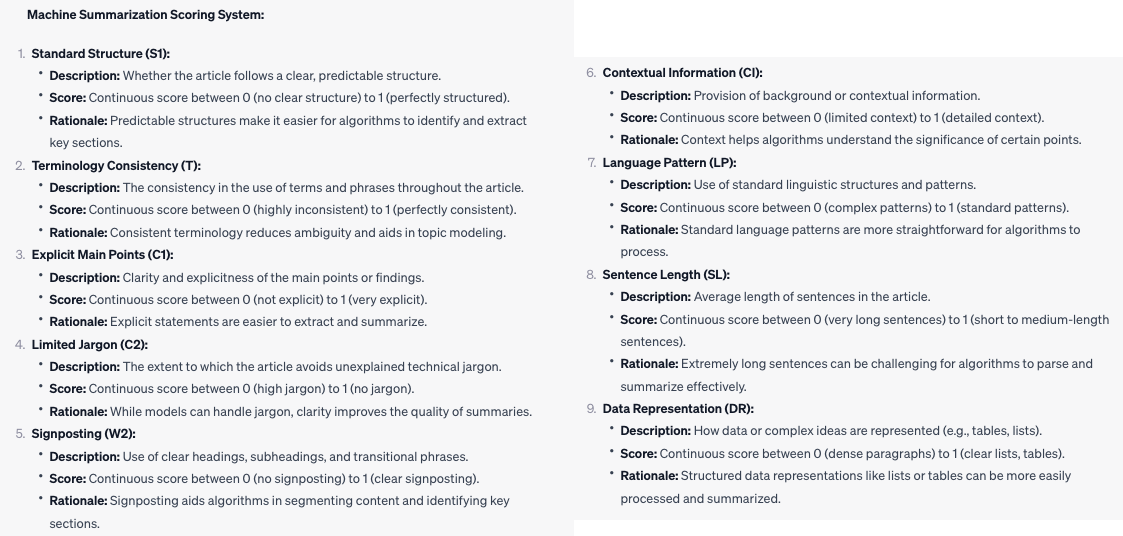
What are the qualities of a good article, from the point of view of an AI tool? In an experiment, I asked ChatGPT to develop a system for scoring articles based on ease of summarization by ChatGPT, rather by humans. ChatGPT quickly developed a elaborate scoring system. See the next image for the factors it took into account.
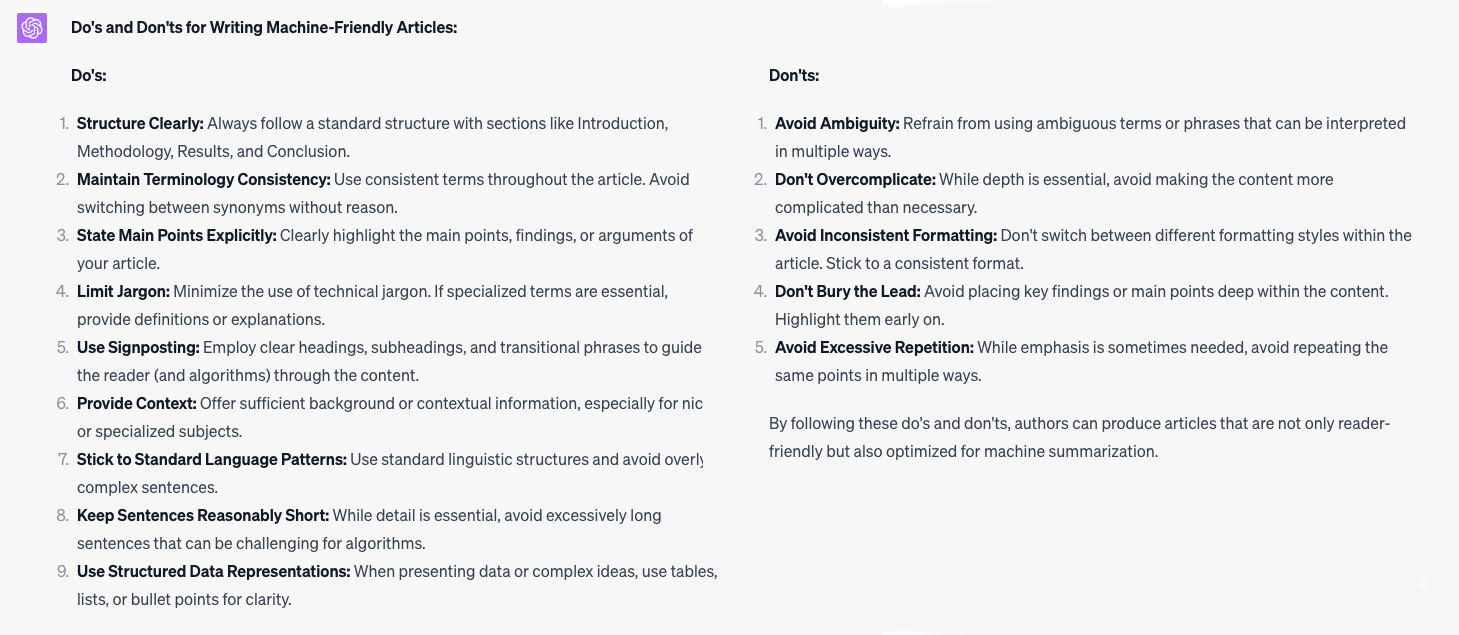
I also asked ChatGPT to provide do’s and don’ts for authors who want to score well on its scoring system. Here’s the advice:
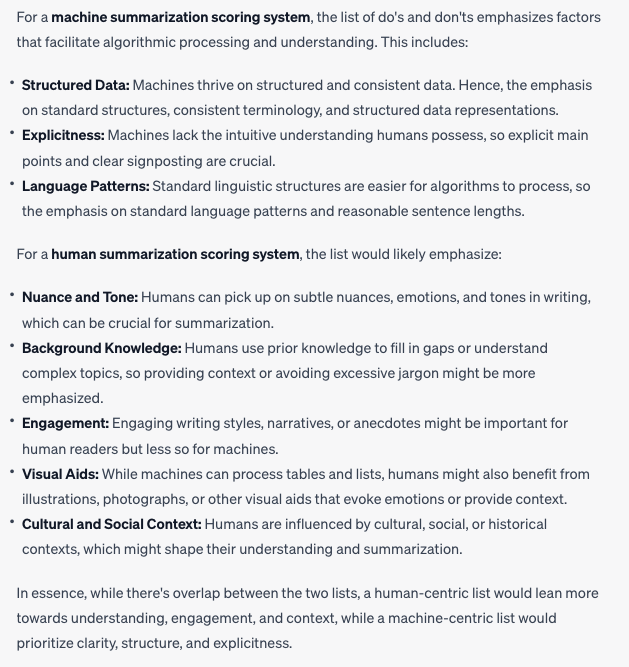
Much of this may seem like the advice you would have given for human readers. But there are key differences, as ChatGPT itself notes:
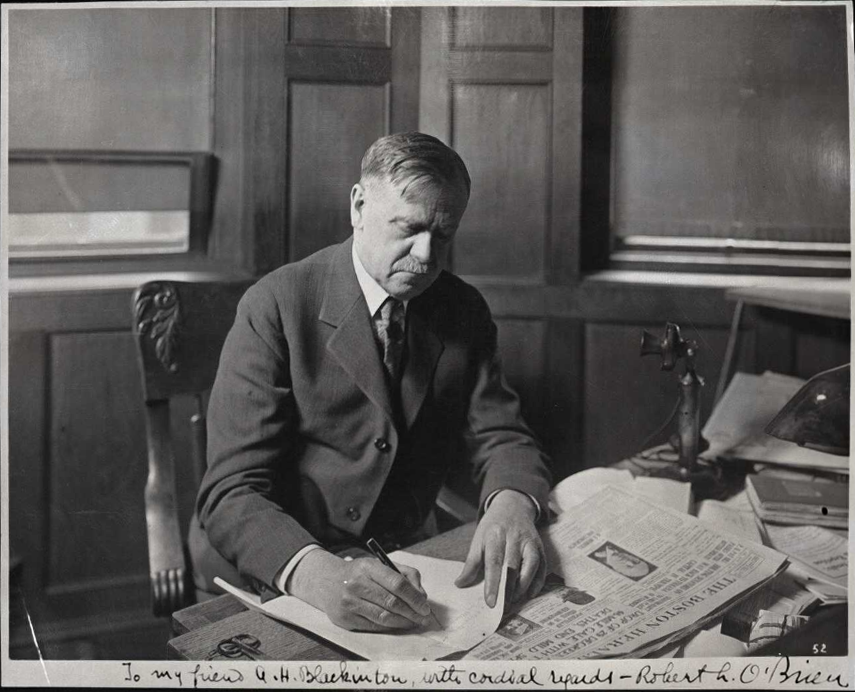
This isn’t the first time that technology has changed the way we write. A century ago, the journalist Robert Lincoln O’Brien (later an editor of the Boston Herald) wrote an article for The Atlantic titled “Machinery and English Style.” The article explained how new technologies like the telegraph and typewriter were changing the written language.
We are going through a similar transformation today, with one important difference. O’Brien was considering how we write. Now technology is changing who we write for. Increasingly, the machine is our reader.


 Alasdair S. Roberts
