Article on Indian federalism
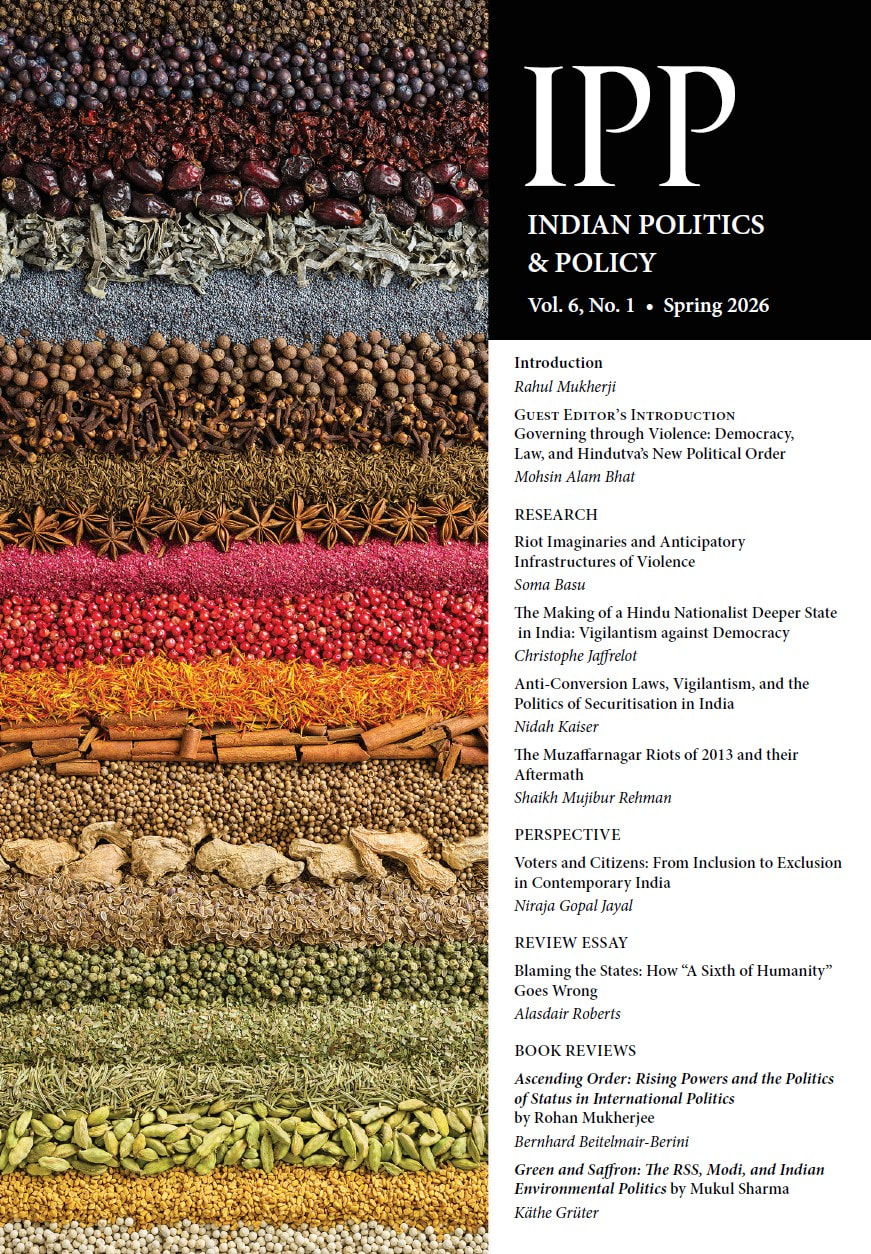
My article on Indian federalism, which uses Kapur & Subramanian’s recent book A Sixth of Humanity as a starting point, is now published in the Spring 2026 issue of Indian Politics & Policy. Read it here.
Aug 18
My article on Indian federalism, which uses Kapur & Subramanian’s recent book A Sixth of Humanity as a starting point, is now published in the Spring 2026 issue of Indian Politics & Policy. Read it here.
I’ve just finished a draft chapter for a forthcoming Edward Elgar volume edited by Maria Aristigueta and Calin Hintea. The volume is titled Democracy and Public Administration: At Risk Around the World, and my contribution is on the interconnected crises of governance in the US and Canada. Title and abstract below. Download here. Comments welcomed!
THE UNITED STATES AND CANADA: TWIN CRISES OF GOVERNANCE | ABSTRACT. The United States is suffering a crisis of governance, and therefore Canada is in crisis as well. The current American “crisis of democracy” is one of several experienced since 1900, all triggered by a collapse in confidence about national strategy in domestic and foreign affairs. The current crisis began before Trump’s election in 2016: since then, Trump’s actions have intensified and mutated the crisis. His policies since 2025 have also up-ended Canadian politics, triggering reconsideration of national strategy in that country too. The United States and Canada are both liberal democratic federations. But there are institutional and cultural differences between the countries that affect the pace and depth of strategic realignment. This chapter reminds us why the field of public administration must pay more attention to macro-level questions about system design, and think more explicitly about the preservation of democratic values, than it has in recent decades.

I’ve written a policy brief for the Centre on Governance and Markets, Why Centralization Goes Wrong. You can download it here.
I’ve revised my working paper, “The Broken Republic.” It is available on SSRN. Comments are appreciated. I’ll be giving a couple of talks based on this paper later in the semester.
Abstract: “Advocates for the American republic have long celebrated its capacity for reinvention in the face of new challenges. But there are strong reasons to question that claim today. The American system of government is broken. It cannot respond effectively to major problems or reconfigure itself to perform better. It would be misguided to blame President Trump alone for this state of affairs. Trump policies are largely a symptom of systemic failure, not the cause. The real weaknesses of the American republic go to the core of its current design, which is not equal to the requirements of a large and complex polity. The system is over-centralized. Federal institutions are incapable of expressing and reconciling the aspirations of American citizens. States lack capacity to compensate for dysfunction in Washington. Political innovation and systemic reform are hampered by a nationalized party duopoly, constitutional rigidity, and populist political culture. In large part, this systemic crisis is the unintended consequence of a century of good-government reforms. Putting the system right will also be a multi-generational project.”
I’ve written a working paper, “The strategic state: Making it work in multilevel democracies,” with Ian Elliott of the University of Glasgow. The paper is on SSRN.

I’ve written a short paper, “The universalization of fragility,” for the international seminar on future trends for the public sector, Instituut voor de Overheid, KU Leuven, February 8-9, 2024. Read the paper here.
The paper will be published in Futures for the Public Sector (Leuven University Press, 2025).
Abstract: “State fragility has been regarded as a problem found only in the developing world. In the twenty-first century, however, it will become a characteristic of states in the Global North as well. Everywhere, leaders and citizens will be preoccupied with basic problems of state cohesion and control. Fears about the decay of political stability and public order may undermine faith in democracy and encourage a shift to authoritarianism. To survive, democratic systems must improve their adaptability and resist the temptation to centralize authority in the face of crisis. Public administration scholars must also revise ideas and methods to remain relevant in this century. New ways of thinking about the field of public administration are required. Unfortunately, it is not clear that scholarly institutions have the motivation to make the necessary changes. So, academia itself faces a problem of adaptability as well.”
 I presented a paper co-authored with Aroon Manoharan at NASPAA’s October conference. The paper describes questions relating to public administration posed within India’s main civil service examination over the past decade. The paper is here. The Powerpoint deck is here.
 I’ve posted a working paper on SSRN: Strategies for Governing: An Approach to Public Management Research for West and East. I will present this paper at the BK21 research workshop on January 11-13, 2018, sponsored by the Graduate School of Public Administration (GSPA) of Seoul National University and the Research for Government hub at SDA Bocconi School of Management. The Powerpoint slides for the presentation are here. The presentation will also refer to my recent article in Perspectives in Public Management and Governance. (Audio of my January 11 presentation is available here.)
I’ve just written a short and preliminary precis for a new project: Crowd Control: Economic Disruption and the Regulation of Mass Protest, which I’ve posted on SSRN. I’ll talk about it at the Graduate Student Conference at Hebrew University next month.


