Interview about new book on Superstates

Here’s an interview in which I talk about my new book, Superstates: Empires of the Twenty-First Century, forthcoming from Polity later this year. Read the interview. The blurb for the book is available here.
Feb 9
Here’s an interview in which I talk about my new book, Superstates: Empires of the Twenty-First Century, forthcoming from Polity later this year. Read the interview. The blurb for the book is available here.
On January 28 I’ll participate in a panel discussion on “decolonizing teaching and research in public administration” organized by the Consortium of Race and Gender Scholars. Details here.

With Professor Noah Rosenblum, I’m moderating an AALS series on the administrative state, bringing together experts in public administration and administrative law.
Details on the October 29 session here.
I’m grateful to my friends in the ASPA Section for International and Comparative Administration for the 2022 Riggs Award for Lifetime Achievement. Story here.
Thirteen sections of the American Society for Public Administration, as well as the Public Administration Theory Network (PAT-Net), have endorsed a statement for Human Rights Day, which is December 10, 2021. It says in part: “As scholars and practitioners working in the field of public administration, we mark this day by reaffirming our commitment to human rights and fundamental democratic freedoms.” Read the full statement here.


I’ll visit the School of Policy Studies at Queen’s University on November 25 to talk to MPA810, Introduction to Public Administration. Topic: Strategies, paradigms and the machinery of government.

With Professor Bill Resh, I’m c-editing a special issue of Perspectives on Public Management and Governance on the connections between public administration, human rights and democracy. See the call for paper abstracts. Deadline for submissions is January 7, 2022.
Nov 3
Here’s the description for Superstates: Empires of the Twenty-First Century, forthcoming from Polity in late 2022. Details and pre-order on the Polity website. Pre-order on Amazon US. Pre-order on Amazon UK.
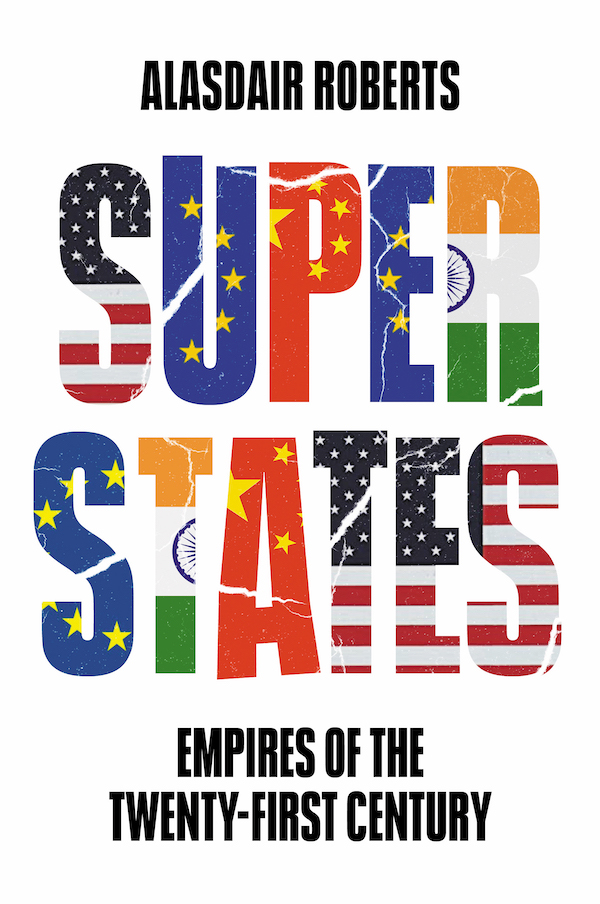
In this century, the world will conduct an extraordinary experiment in government. In 2050, forty percent of the planet’s population will live in just four places: India, China, the European Union, and the United States. These are superstates — polities that are distinguished from normal countries by expansiveness, population, diversity, and complexity.
How should superstates be governed? What must their leaders do to hold these immense polities together in the face of extraordinary strains and shocks? Alasdair Roberts looks to history for answers. Superstates, he contends, wrestle with the same problems of leadership, control and purpose that plagued empires for centuries. But they also bear heavier burdens than empires — including the obligation to improve life for ordinary people and respect human rights.
One axiom of history was that empires always died. Size and complexity led to fragility, and imperial rulers improvised constantly to put off the day of reckoning. Leaders of superstates are doing the same today, pursuing radically different strategies for governing at scale that have profound implications for democracy and human rights. History shows that there are ways to govern these sprawling and diverse polities well. But this requires a different way of thinking about the art and methods of statecraft.

On October 29, I’ll participate in a panel on state secrecy as part of the 2021 International Conference of Information Commissioners. Details here.

I’ll be the plenary speaker for the closing day of the NASPAA-South Asia conference on November 13, 2021. Title of my talk: “Can democracy work in supersized polities?” Conference details here. Watch the talk here.


