Talk with Jeff Santos about “Four Crises”
 My conversation with Jeff Santos about Four Crises of American Democracy can be heard here.
Oct 12
My conversation with Jeff Santos about Four Crises of American Democracy can be heard here.
Early reviews for Four Crises of American Democracy, from the Oxford University Press website:
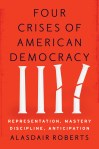 “Already among our foremost observers of global capitalism, economic policymaking, and the information age, Alasdair Roberts in his latest book expertly details four periods of crisis of American democracy across the past hundred-plus years. The reassuring news: the parlous state of our current national politics has ample historical precedent-and the republic survives. The better news: each crisis period contained the seeds of democratic renewal, providing genuine hope for our own future. Roberts’s clarion voice is one that deserves a full hearing from U.S. officialdom and citizenry alike.”- Rogan Kersh, Provost and Professor of Politics & International Affairs, Wake Forest University
“In this sharp and insightful analysis, Roberts takes dead aim at a central puzzle of our time: is American democracy so sick that it risks sliding deeply into chaos, even oblivion? The book takes measured stock of the challenges democracy faces. But even more important, Roberts finds that democracy has faced big crises before and has found within itself what it takes to conquer them. The result is an exceptionally clear-eyed look at the issues we face and how we can solve them. It’s must reading-especially for those trapped in despair about our system of government.”-Donald F. Kettl, Professor of Public Policy, University of Maryland
 In the current issue of New Left Review, Malcolm Bull discusses my 2013 book, The End of Protest. Go to the article. Bull writes: “There have been places, notably neo-liberal core countries like the USA and UK, where political protests have been small, sporadic and ineffectual. . . . In The End of Protest, Alasdair Roberts attributes this change to the growing intolerance of public unrest in market societies, and the effectiveness of policies of repression (legal changes with strengthened police forces to enforce them) and containment (the manipulation of urban space, enhanced surveillance and kettling), combined with economic appeasement (fiscal stimulus and quantitative easing) carried out by technocrats at central banks rather than the government itself. The result has been the atrophy of traditional forms of mass organization and the failure of new forms of networked protest to take their place.” The End of Protest will be available in paperback from Cornell University Press in November.
 My 2008 book The Collapse of Fortress Bush, published by New York University Press, is now available on Kindle. Details here. Kirkus Reviews called the book “A trenchant analysis of the last eight years of American political history. . . . A work of rare insight that fills gaps glaringly evident in most public discourse.” Choice said: “Roberts’ sound judgment and expertise in the field of public administration make this an excellent primer on governance in the Bush years.”
In the current issue of Public Administration Quarterly, Chester Robinson and Gloria Billingsley discuss my 2013 monograph Large Forces: What’s Missing in Public Administration: “Many problems on the public policy agenda reflect environmental factors, including political, economic, shifts in populations from farms to cities, and social conventions, some of which our society and leaders are not eager to take on. Alasdair Roberts, and other organic theorists, see the country’s policy decisions as being buffered by these powerful forces. To them, it seems impossible to fully understand the actions of government without studying the large forces that caused the problem to come into being. What government does, and how it does it, cannot be explained without accounting for the pressure applied by these forces. Large forces scholarship helps us to produce rigorous, persuasive and contextual answers to public policy issues.” Read their article.
 On Baidu.com, Lihua Fang discusses my 2013 monograph, Large Forces: What’s Missing in Public Administration. Read Fang’s comment in Chinese. Read the Google translation.
 I spoke with Ken Newton of the St. Joseph Free-Press about my forthcoming book Four Crises of American Democracy. Read the article.
 Public Radio’s Backstory has just rebroadcast a show that includes a discussion between me and Peter Onuf of the University of Virginia on the development of policing in the United States. The interview drew on work from America’s First Great Depression and The End of Protest. Listen to BackStory’s show on policing in America. My interview begins at the fifteen-minute mark. My segment is titled “Running the riot.”
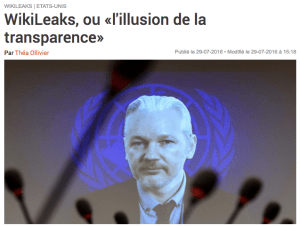 I’m quoted in a July 29 story by Radio France Internationale on WikiLeaks. Read the story. I provided a skeptical view about WikiLeaks’ impact in a 2011 article in the Wilson Quarterly, The WikiLeaks Illusion. Read the 2011 article. A longer academic version of that article also appeared in the International Review of Administrative Sciences in 2012. Read the 2012 article.
I gave the keynote address at the 3rd International Conference on Democratic Governance in the Developing World in Washington, DC on July 19. My topic was “One world: Building a single body of knowledge for statecraft.” Listen to the address here | Overview of the conference here.


 Alasdair S. Roberts

