Accenture talk on Strategies for Governing
I’ll give a talk on my book Strategies for Governing for the global Health & Public Service team at Accenture Research on June 19. Powerpoint slides for the talk are here. The book can be ordered here.
Jun 18
I’ll give a talk on my book Strategies for Governing for the global Health & Public Service team at Accenture Research on June 19. Powerpoint slides for the talk are here. The book can be ordered here.
I will present my paper, “Bridging Levels of Public Administration: How Macro Shapes Meso and Micro” at the Public Management Research Conference on June 12. Paper is here. PDF of Powerpoint is here. The conference program is here.
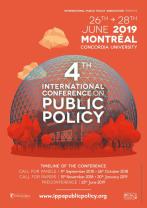 I will co-chair a panel on administrative traditions in public administration research at International Conference on Public Policy (ICPP4) in Montreal on June 27. Details about the panel here.
 I will participate in the closing plenary panel at the annual conference of the Canadian Association of Programs in Public Administration (CAPPA) in Montreal on May 24. The topic: “Public Administration Scholarship in Canada: From an uncomfortable conversation to a productive strategic dialogue.” The conference program is here. My own contribution will be based on this comment written for Canadian Public Administration last year.
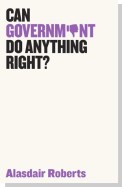 Public Administration Review has just published a review of Can Government Do Anything Right? The review by Alfred T.-K. Ho also looks at Can Government Earn Our Trust? by Donald Kettl. Ho says the books are “timely, well organized, and highly accessible . . . Both deserve much attention in our field and have set the stage for more future dialogue and a much-needed rethinking of democratic governance in the twenty-first century.” Read the review.
 I was a panelist at the conference on public affairs education in South Asian co-hosted by the O.P. Jindal Global University and NASPAA in Sonipat, India on February 25-26.
Feb 25
Comment from Donald Kettl of the LBJ School of Public Affairs on Strategies for Governing (Cornell University Press, December 2019): “Alasdair Roberts is one of the most thoughtful scholars working in public administration today, and Strategies for Governing is an important and challenging book. It will be an instant classic—a must-read for established researchers and budding scholars.”
Mary Guy of the University of Colorado-Denver: “Just in time, Alasdair Roberts makes a provocative argument urging public administration to return to basics! Strategies for Governing rediscovers the field’s roots and describes a conceptual and practical route back to relevance in public life.”
Evert Lindquist, School of Public Administration, University of Victoria: “Written before the COVID-19 epidemic struck, Alasdair Roberts’ Strategies for Governing is a remarkable book for these disconcerting times. Roberts calls for reinvigoration of public administration research and debate about the overall priorities and structure of our public administration systems, arguing that scholars have focused too much on specific public management challenges over the last thirty years. Like the progenitors of the scholarly field of public administration, he asks us to think about designing macro governing strategies for the grand challenges we will face over the next decade and beyond.”
Richard Callahan, University of San Francisco: “Strategies for Governing engages the readers in the big questions of the practice and study of public administration, breaking new ground in connecting strategy with governance. Roberts crafts a compelling argument for connecting public administration to its founding values and questions as a way of moving forward in this century.”
“Roberts succinctly makes a timely case in favor of large concerns about governing . . . While dealing with currently urgent realities of the field, the analysis makes a contribution to last.” — American Review of Public Administration, June 2020.
“Roberts is masterful at distilling complex concepts into a digestible format, through which both new students and senior scholars can engage and argue. The book provides an opportunity to have a critical conversation about the boundaries of Public Administration.” — Governance, July 2020.
“Overall, Strategies for Governing has broad implications for research, teaching, and practice in a variety of disciplines and subfields. The book’s insights provide readers with fresh perspectives on important research questions in public administration, public policy, American politics, international relations, and comparative politics. Perhaps most notably, Roberts encourages us to return to first principles and to address the ‘what’ and ‘how’ of government.” — Perspectives on Politics, August 2020.
“[Roberts] has nudged us in the right direction to reawaken why public administration . . . is a field uniquely situated to link theory and practice at a macro-societal level . . . On that point alone, we all owe Roberts a great intellectual debt.” — Journal of Public Administration Research and Theory, October 2020.
 I’ll talk about my book Can Government Do Anything Right? in Professor Jon Rose’s class on Contemporary Issues in Politics at Queen’s University on March 25.
 I’ll speak at the School of Government of the Universidad de los Andes in Bogotá, Colombia, February 11-12, 2019. The title of my talk: “Governing well in a turbulent world.” PDF of Powerpoint here.
 Dean Sherry Glied of the NYU Wagner Graduate School of Public Service comments on Can Government Do Anything Right?, published by Polity Books in April 2018: “Alasdair Roberts’ pithy, accessible, and refreshingly non-partisan book offers a pragmatic yet optimistic view of the benefits and future of government. While thoughtfully acknowledging a broad range of complaints about the representativeness and effectiveness of Western democracies, Roberts persuasively counters by pointing out the undeniable progress and accomplishments of these governments. His broad thesis–that democratic institutions work because they adapt to changing circumstances, often in unexpected ways–should provide both hope and inspiration to students and readers who despair about our current situation.” See all comments on this book.


 Alasdair S. Roberts
