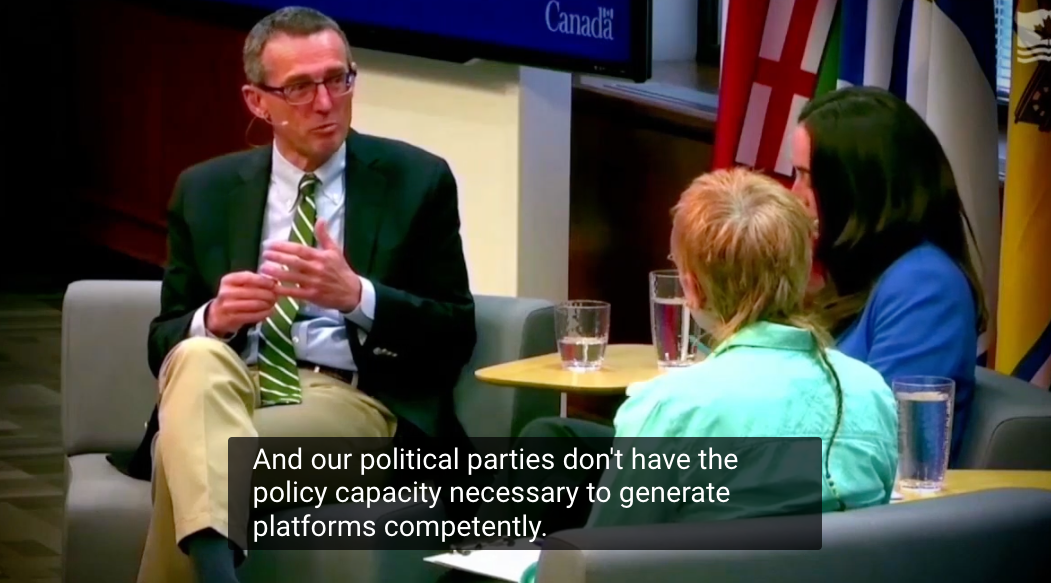
Quoted in Policy Option article
My comments on the need for a broad review of the role and structure of the Canadian federal public service, are included in this Policy Options piece by Kathryn May.
Sep 21
My comments on the need for a broad review of the role and structure of the Canadian federal public service, are included in this Policy Options piece by Kathryn May.
I’ve written a Policy Brief on adaptable government for the School of Global Affairs and Public Policy at American University Cairo. Download the policy brief here. This is based on my current book project, The Adaptable Country.
On the Policy Options website, Mark Robbins discusses my book Superstates: “Superstates offers clever insights about the conduct of public administration. . . . It also makes important connections between tactical issues of public administration and the longer-term implications for its nature and structure.” Read the article.
On June 22, I delivered the 2023 Jocelyne Bourgon Visiting Scholar lecture at the Canada School of Public Service. More information here.
A short note, based on recent experience with ChatGPT and other AI applications.
In the future, academics will write articles that are designed to be read by AI applications, not by other humans. Our understanding of good writing style will adjust to fit the needs of those applications.
Just as we design web pages so that they fit the requirements of search engines (search engine optimization, SEO), we will write articles with AI optimization (AIO) in mind.
We will do this for two reasons:
Read moreIn the journal Global Public Policy and Governance, Professor Suparna Soni reviews Superstates: Empires of the Twenty-First Century. “The book serves as an invaluable resource for researchers, students and practitioners grappling with the enduring dilemmas of contemporary government,” Soni says. “Readers will find his discussion to be eloquent, perceptive and enlightening.” Read the full review.
In Spring 2024, I’ll teach a new graduate course on human rights and public administration. The draft overview is below. I’ll post more details in September.
All people are entitled to certain fundamental rights. This principle, sometimes known as the doctrine of human rights, became central to governance after World War II. Today, debates about the role of government around the world are shaped by understandings about the scope of human rights. For decades, policymakers had invented agencies and programs to protect different rights. Some of these experiments have worked better than others. Governments have learned about the most effective techniques for advancing rights, and the extent to which rights protection may be constrained by realities of administration.
This course will examine the relationship between high-level thinking about human rights and more concrete problems of policy design and implementation. Our objectives are to:
In 2024, the course will draw mainly on American experience since World War II, although there will be frequent references to experiments in governance in other countries.
I delivered a keynote address at the National Conference on Resilient Institutions hosted by the Institute for Research on Public Policy in Ottawa on June 13, 2023. More details about the lecture here.
The text of the lecture is available here.
Joshua Huminski reviews my book Superstates for Diplomatic Courier: “Superstates finds a nice balance between academic curiosity and practical utility and overcomes the limitations of comparative political definitions to identify real challenges shared across four distinct political structures. It is a useful framework for looking at what will be a very dynamic period of both domestic and international politics.” Read the review.
Superstates: Empires of the Twenty-First Century is profiled by Politics Today. “With a groundbreaking twist in thinking about the art and methods of statecraft, Roberts considers the decisions leaders must make to devise and redevise strategies for governance at such a grand scale.” Read the review here.